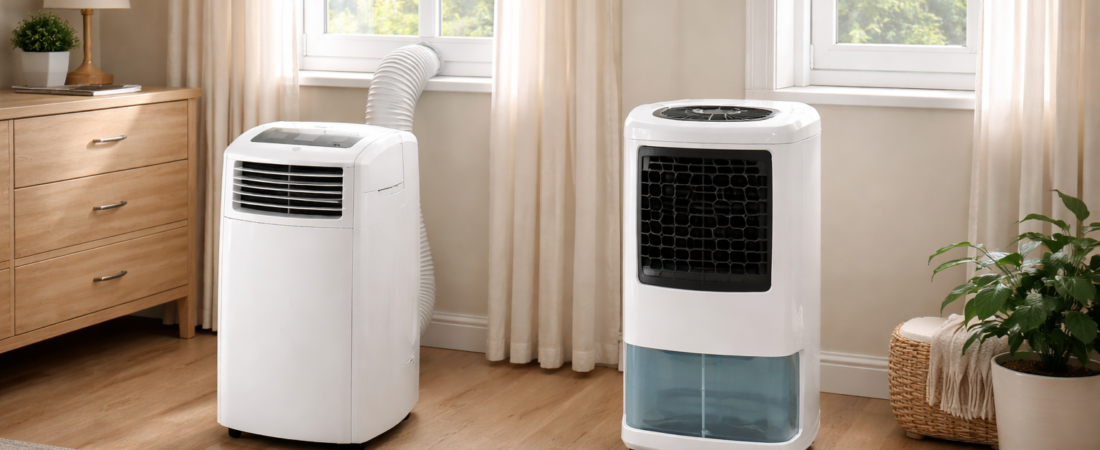
Both evaporative coolers and portable air conditioners are marketed as solutions for cooling small indoor spaces. At first glance they appear similar — compact units that sit on the floor and blow cool air into a room.
However, the two devices work in completely different ways and are designed for different environments.
Understanding the difference is important because in the wrong conditions, an evaporative cooler may provide little to no cooling effect, while a portable air conditioner can cool a room regardless of humidity.
How Portable Air Conditioners Work
A portable air conditioner cools a room using the same refrigeration process used in standard air conditioning systems.
The unit pulls warm air from the room and passes it across refrigerant coils that absorb heat. That heat is then removed from the room through an exhaust hose that vents outside through a window.
The cooled air is circulated back into the room while the heat is expelled outdoors.
Because heat is physically removed from the room, portable air conditioners can reduce the indoor temperature reliably, even in hot or humid climates.
Most models are designed to cool spaces between about 150 and 700 square feet depending on their BTU rating.
If you’re unsure what cooling capacity your room requires, see How Many BTUs Do I Need for a Portable Air Conditioner?
How Evaporative Coolers Work
Evaporative coolers operate using a completely different principle.
Instead of refrigeration, they cool air through the natural process of water evaporation.
Warm air is pulled through water-saturated pads inside the unit. As the water evaporates, it absorbs some heat from the air, slightly lowering the air temperature before blowing it into the room.
Because evaporation is the cooling mechanism, evaporative coolers require a steady supply of dry air to work effectively.
They do not remove heat from the room the way an air conditioner does.
The Biggest Difference: Humidity
Humidity is the single biggest factor that determines whether an evaporative cooler will work.
Evaporative cooling becomes much less effective as humidity increases. When the air is already full of moisture, evaporation slows dramatically.
In humid climates, evaporative coolers may lower the temperature only slightly or may simply blow damp air around the room.
Portable air conditioners do not rely on evaporation in the room air. Instead, they remove both heat and moisture as part of the refrigeration process.
This allows them to cool rooms reliably even in high humidity environments.
You can learn more about how humidity affects portable AC performance in Do Portable Air Conditioners Work in High Humidity?
Venting Requirements
Another key difference between these two systems is ventilation.
Portable air conditioners must vent hot air outdoors using a window exhaust hose. Without venting, the unit would simply recycle heat back into the room.
Many people wonder whether portable air conditioners can operate without this venting system. The limitations are explained in Can a Portable Air Conditioner Be Used Without a Window?
Evaporative coolers typically do not require window venting.
However, they do require fresh airflow. Windows or doors usually need to remain open to allow warm air to exit the room and prevent humidity buildup.
In enclosed spaces with limited ventilation, evaporative coolers can quickly increase indoor humidity.
Cooling Performance
When comparing cooling performance, the two devices serve different purposes.
Portable air conditioners are capable of actively cooling a room to a target temperature. Most units include a thermostat that cycles the compressor on and off to maintain that temperature.
Evaporative coolers do not maintain a specific temperature. Instead, they provide a cooling effect similar to a strong fan with slightly cooler air.
In very dry climates this effect can feel comfortable, but it typically cannot match the cooling power of an air conditioner.
Energy Use
Evaporative coolers generally consume less electricity because they use a fan and water pump rather than a refrigeration compressor.
Portable air conditioners require more energy because they operate a full refrigeration cycle to remove heat from the room.
However, the difference in energy use often reflects the difference in cooling capability.
Evaporative coolers provide mild cooling, while portable air conditioners are designed to control the temperature of a room.
When an Evaporative Cooler Might Make Sense
Evaporative coolers tend to work best in environments that are:
Very dry
Well ventilated
Moderately warm rather than extremely hot
They are sometimes used in desert climates or outdoor spaces where airflow is constant.
In small enclosed rooms, however, their cooling effect is usually limited.
When a Portable Air Conditioner Is the Better Option
Portable air conditioners are generally the more reliable option for cooling indoor spaces such as:
Bedrooms
Apartments
Home offices
Studio apartments
Small living rooms
Because they remove heat from the room, they can maintain consistent cooling regardless of humidity conditions.
For a deeper look at models designed specifically for smaller rooms, see Portable Air Conditioners for Small Spaces.
Final Thoughts
Although evaporative coolers and portable air conditioners are often grouped together in product listings, they solve different problems.
Evaporative coolers rely on water evaporation and work best in dry, well-ventilated environments.
Portable air conditioners use refrigeration to remove heat from a room, allowing them to cool indoor spaces more reliably across a wide range of climates.
For most small indoor rooms — especially apartments, bedrooms, and home offices — a portable air conditioner will typically provide more consistent and predictable cooling.