Choosing the right size portable air conditioner is one of the most important factors in achieving comfortable, efficient cooling. Many people assume that buying a higher-BTU unit will automatically deliver better results, but incorrect sizing often leads to poor performance, higher electricity costs, and uncomfortable indoor conditions.
This guide explains how portable AC sizing works, how to calculate the correct BTU range for your room, and which real-world factors affect cooling performance beyond simple square footage.
Portable AC BTU Calculator
Estimate the ideal BTU range for your room based on size and conditions.
Why Correct Portable AC Sizing Matters
Portable air conditioners are designed to remove heat and moisture from a room at a specific rate. When the unit’s cooling capacity matches the space it’s cooling, the system operates efficiently and maintains steady comfort.
When the sizing is wrong, problems arise.
An undersized unit struggles to lower temperatures, runs continuously, and consumes excessive energy without delivering relief. An oversized unit cools the air too quickly and shuts off before removing enough humidity, creating a cold but clammy environment and causing frequent on-off cycling that stresses the compressor.
Correct sizing avoids both issues and delivers balanced cooling.
What BTUs Actually Mean
BTU stands for British Thermal Unit, a standard measurement of heat energy. In air conditioning, BTUs indicate how much heat a unit can remove from a space in one hour.
Higher BTU ratings mean more cooling capacity, but more capacity is only beneficial when it matches the room’s heat load. BTUs should always be selected based on room size and environmental conditions, not budget or availability alone.
Start With Room Size (Square Footage)
The first step in sizing a portable AC is calculating the square footage of the room.
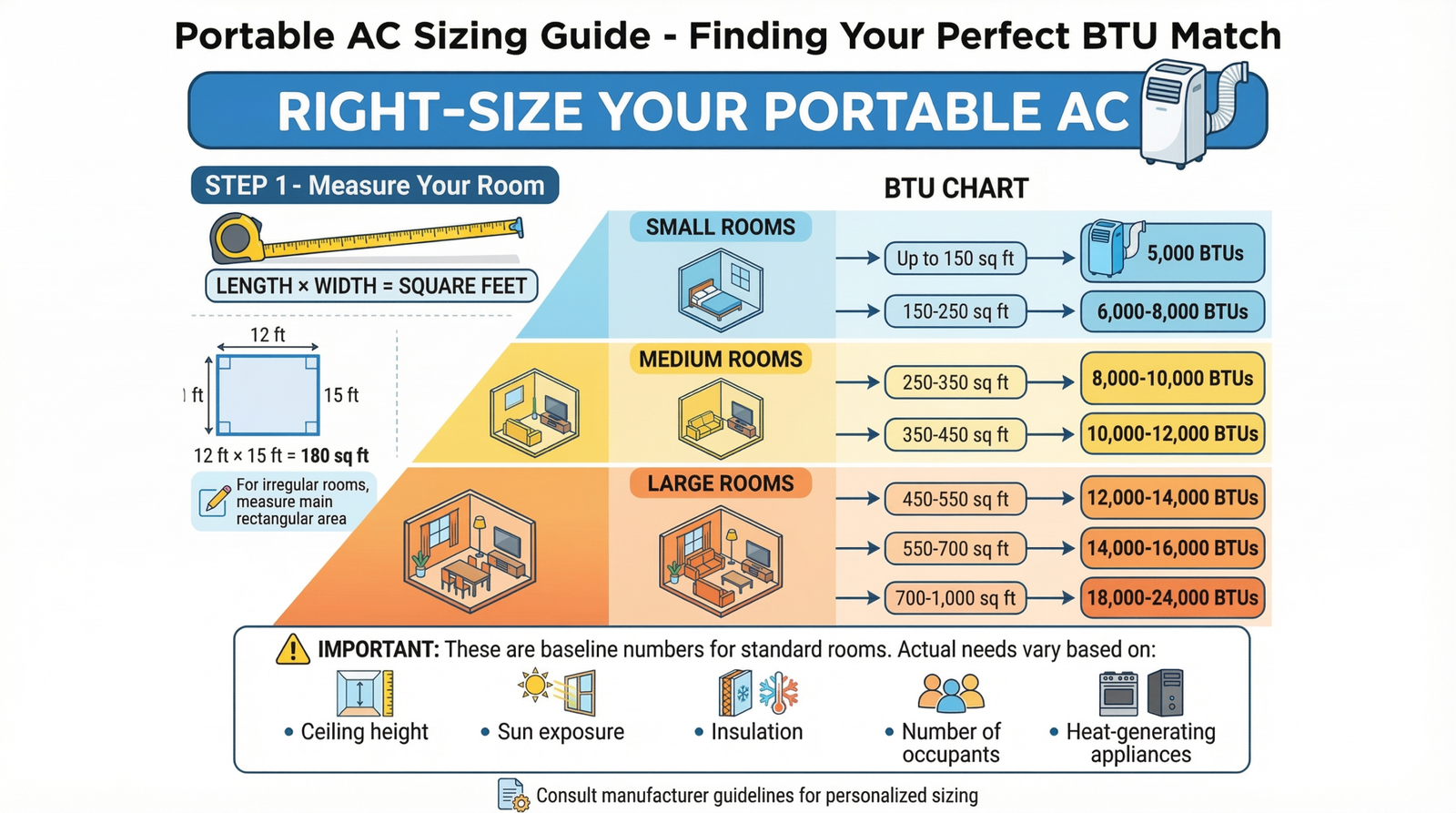
Measure the room’s length and width in feet, then multiply them together. For example:
-
12 ft × 15 ft = 180 square feet
This number provides the baseline for BTU selection.
For irregularly shaped rooms, measure the main usable area rather than including closets or hallways.
General BTU Guidelines by Room Size
These ranges provide a starting point under typical conditions:
-
Up to 150 sq ft: ~5,000 BTU
-
150–250 sq ft: ~6,000–8,000 BTU
-
250–350 sq ft: ~8,000–10,000 BTU
-
350–450 sq ft: ~10,000–12,000 BTU
-
450–550 sq ft: ~12,000–14,000 BTU
For medium rooms, this guide to the best portable air conditioners for 300–500 sq ft rooms explains which capacities and models perform best in real-world use.
Adjusting BTUs for Real-World Conditions
Standard BTU charts assume average conditions. Most rooms require adjustments based on environmental factors.
Ceiling Height
Rooms with ceilings higher than 8 feet require more cooling capacity. Add approximately 10% more BTUs for each additional foot of ceiling height.
Sun Exposure
Rooms with strong afternoon sun exposure, especially south- or west-facing windows, should add 10% more BTUs. Heavily shaded rooms may require slightly less.
Room Occupancy
BTU charts assume two occupants. Add 600 BTUs per additional person who regularly uses the room.
Heat-Producing Appliances
Home offices, kitchens, and entertainment rooms generate extra heat. Add 3,000–4,000 BTUs for rooms with computers, TVs, or kitchen appliances.
Insulation Quality
Older buildings with poor insulation and single-pane windows may require 10–20% more BTUs to maintain comfort.
Single-Hose vs Dual-Hose Portable ACs
BTU capacity is not the only factor that affects cooling performance.
Single-hose portable ACs are more common and less expensive, but they create negative air pressure by exhausting indoor air outside. This pulls warm air back into the room through cracks and gaps, reducing efficiency.
Dual-hose portable ACs draw air from outside for cooling and exhaust it back out, maintaining neutral pressure. They cool faster and maintain temperature more consistently, especially in larger rooms or poorly insulated spaces.
For continuous or all-day cooling, dual-hose units are generally more effective.
Energy Efficiency: EER and SACC Ratings
BTUs indicate cooling capacity, but efficiency determines operating cost.
-
EER (Energy Efficiency Ratio) measures how efficiently electricity is converted into cooling. Higher numbers mean better efficiency.
-
SACC (Seasonally Adjusted Cooling Capacity) provides a more realistic measure of portable AC performance under real-world conditions.
SACC ratings are typically 20–30% lower than advertised BTU ratings, which is why a 14,000 BTU unit may deliver closer to 10,000 BTUs of actual cooling.
When available, SACC ratings should be used to compare models accurately.
Common Portable AC Sizing Mistakes
-
Choosing the largest unit available instead of calculating BTUs
-
Ignoring ceiling height and sun exposure
-
Attempting to cool multiple rooms with one portable AC
-
Underestimating the impact of poor installation
-
Failing to seal exhaust hose gaps properly
Even a correctly sized unit will perform poorly if the exhaust system leaks hot air back into the room.
Once you’ve narrowed your room size, this breakdown of 8,000 BTU portable air conditioners for small rooms helps compare models designed for bedrooms, dorms, and compact living spaces.
Sizing Portable ACs for Different Living Situations
Bedrooms
Bedrooms typically require 8,000–10,000 BTUs, depending on size and noise sensitivity. For quieter operation, see our comparison of portable air conditioners for bedrooms.
Home Offices
Electronics add heat. Most home offices benefit from one BTU tier higher than bedroom charts suggest.
Apartments
Noise levels and installation flexibility matter. Proper placement can reduce perceived sound, which is covered in our guide on portable air conditioner placement for quiet sleep.
RVs and Tiny Homes
Limited insulation and power availability often require slightly higher BTU ratings than square footage alone would indicate.
Key Takeaways
Choosing the right portable AC size starts with room square footage, but real-world performance depends on ceiling height, sunlight, insulation, and usage patterns.
Oversized units cause humidity issues and energy waste, while undersized units struggle to cool effectively.
Single-hose designs are adequate for small spaces, but dual-hose systems offer superior efficiency for larger rooms.
Energy efficiency ratings like EER and SACC provide important insight beyond simple BTU numbers.
Proper installation and sealing are just as important as selecting the correct cooling capacity.